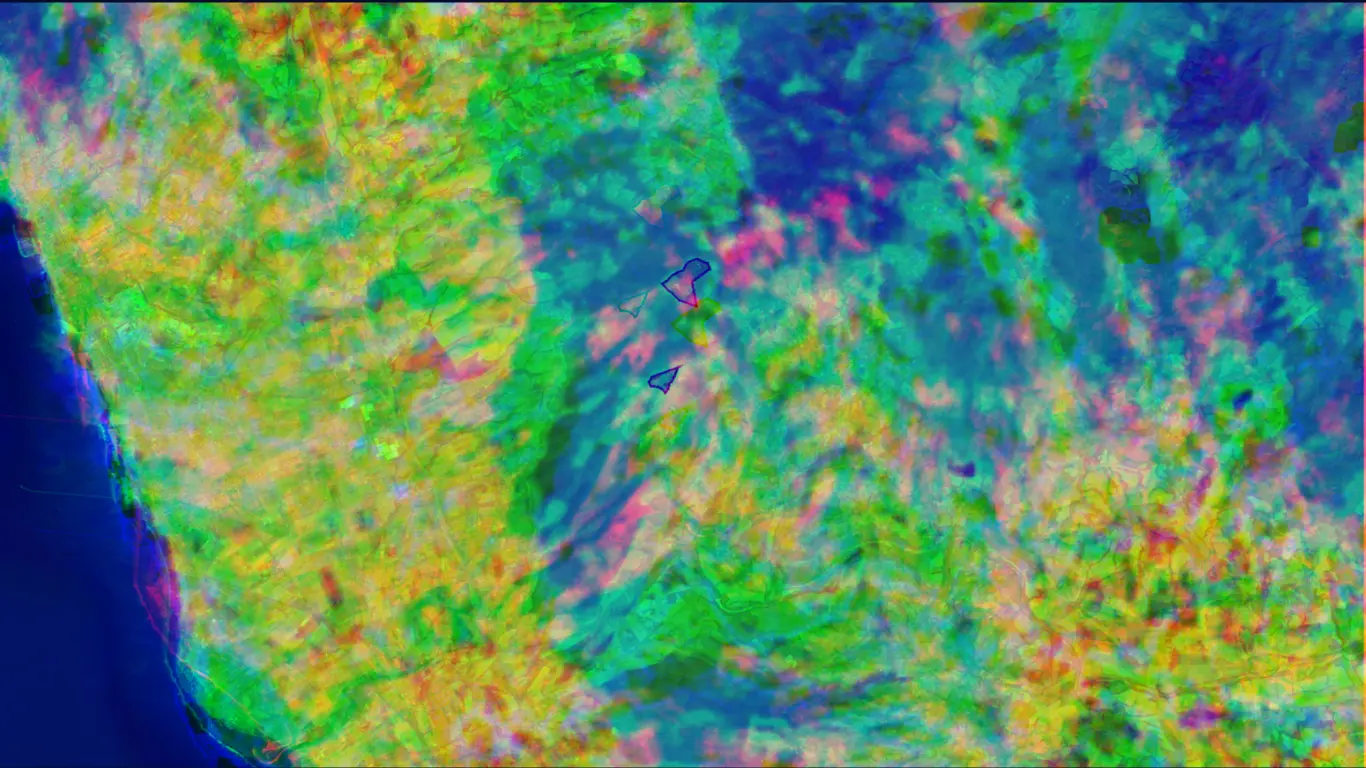
NDMI — Normalized Difference Moisture Index
Measure vegetation moisture from space
The NDMI (Normalized Difference Moisture Index) measures vegetation water content using Sentinel-2 satellite imagery. It is one of the most reliable remote-sensing indicators for water stress, drought monitoring and forest health assessment.
What is NDMI?
NDMI stands for Normalized Difference Moisture Index. It is a satellite-derived vegetation index that quantifies the moisture content of leaves and canopies by combining a near-infrared (NIR) band with a shortwave-infrared (SWIR) band.
Vegetation reflects strongly in the near-infrared region of the electromagnetic spectrum, while liquid water in leaf tissue absorbs energy in the shortwave-infrared region. By contrasting these two signals, NDMI isolates the water content of vegetation from the surrounding signals of soil, atmosphere and pigments.
The index ranges from -1 to +1. Negative values typically correspond to bare soil, water bodies, or stressed vegetation; positive values indicate progressively higher moisture content. Healthy, well-watered canopies usually fall between 0.2 and 0.6, while saturated wetlands can exceed 0.6.
Compared to chlorophyll-based indices such as NDVI, NDMI responds faster to water stress, often days or weeks before any change is visible to the naked eye. This makes it a leading indicator for irrigation decisions, drought early warning, fuel-load assessment, and forest disturbance detection.
Formula
NDMI = (NIR - SWIR) / (NIR + SWIR)
Where NIR is near-infrared reflectance and SWIR is shortwave-infrared reflectance.
How NDMI is calculated
On Xnatura, NDMI is computed from Copernicus Sentinel-2 multispectral imagery. The two bands required are B8A (near-infrared, narrow) and B11 (shortwave-infrared 1).
Sentinel-2 B8A — NIR
Narrow near-infrared band centred at 865 nm with 20 m native resolution. Healthy vegetation reflects strongly in this region, providing the canopy structure signal.
Sentinel-2 B11 — SWIR
Shortwave-infrared band centred at 1610 nm with 20 m native resolution. Liquid water in leaves absorbs energy at this wavelength, making it the moisture-sensitive component of the index.
Spatial resolution
NDMI is delivered at 10–20 m per pixel, fine enough to distinguish individual fields, forest stands, and urban green areas.
Temporal resolution
Sentinel-2A and Sentinel-2B together provide a revisit time of around 5 days at the equator, enabling near-continuous monitoring of vegetation moisture.
Cloud, shadow and snow masks are applied automatically; the resulting NDMI raster is georeferenced and ready for analysis on the Xnatura platform.
NDMI value ranges and interpretation
Reading NDMI is straightforward once the typical bands of values are known. The thresholds below are commonly used in agronomy, forestry and ecology, but they should always be calibrated against ground truth and seasonal baselines for a given region.
- -1.0 to -0.2
Severe water stress or non-vegetated
Bare soil, sealed surfaces, dormant vegetation or canopies with critical water deficit. In agriculture, this band typically signals an urgent irrigation need or end-of-cycle senescence.
- -0.2 to 0.0
Low moisture
Sparse vegetation, dry herbaceous cover or early signs of water stress in cropland and forest stands. A persistent drift towards this band is a robust drought early-warning signal.
- 0.0 to 0.2
Moderate moisture
Vegetation under normal-to-mild stress. Common in mid-summer Mediterranean conditions, in rainfed agriculture during dry spells, and in mature forests at the end of the dry season.
- 0.2 to 0.4
Good moisture
Healthy, well-watered canopies. Typical of irrigated cropland during peak season, deciduous forests in spring, and managed grasslands after rainfall.
- 0.4 to 1.0
High moisture or saturation
Wetlands, riparian vegetation, dense canopies after heavy rain, or mixed pixels containing standing water. Sustained values in this band can indicate water-logging or flooding.
NDMI use cases
Because NDMI reacts to changes in canopy water content earlier than visible-spectrum indices, it is used across agriculture, forestry, environmental assessment and climate-risk analysis.
Precision irrigation in agriculture
Track moisture stress at field and sub-field level, prioritise irrigation rounds, and reduce water consumption while preserving yield. Combined with weather data, NDMI supports variable-rate irrigation strategies for vineyards, orchards, row crops and protected horticulture.
Forestry and drought monitoring
Detect early signs of drought in forest stands, monitor fuel-load conditions for wildfire risk, and quantify post-disturbance recovery after fires, windthrow or pest outbreaks. NDMI complements NDVI in identifying stressed conifer plantations long before visible defoliation.
Environmental impact assessment
Quantify pre- and post-construction effects on vegetation moisture around infrastructure, mining sites and industrial facilities. NDMI time series provide objective, repeatable evidence for Environmental Impact Assessments (EIA) and biodiversity baselines.
Climate risk and resilience
Integrate NDMI trends into climate-risk dashboards to map drought exposure of supply chains, real-estate portfolios and protected areas. Multi-year anomalies highlight the locations where water stress is intensifying under climate change.
NDMI vs NDVI vs NDWI
NDMI is often confused with NDVI (Normalized Difference Vegetation Index) and NDWI (Normalized Difference Water Index), but each index measures a different physical property of the surface. NDVI uses red and near-infrared bands and tracks chlorophyll activity, making it ideal for biomass and greenness. NDWI replaces red with green and is designed to detect open water bodies. NDMI uses near-infrared and shortwave-infrared bands and is specifically tuned to canopy water content. In practice, NDVI tells you whether vegetation is photosynthetically active, NDWI tells you whether the surface contains liquid water, and NDMI tells you how hydrated the vegetation itself is. Used together, these three indices give a complete picture of vegetation status, from greenness to moisture to free-water extent.
How Xnatura uses NDMI
On the Xnatura platform, NDMI is delivered as a ready-to-use satellite layer for any monitored site, with daily-to-weekly composites, multi-year time series and customisable alert thresholds. Analysts can compare NDMI dynamics against NDVI, land-surface temperature, precipitation and field IoT sensors in a single interface.
Explore all satellite maps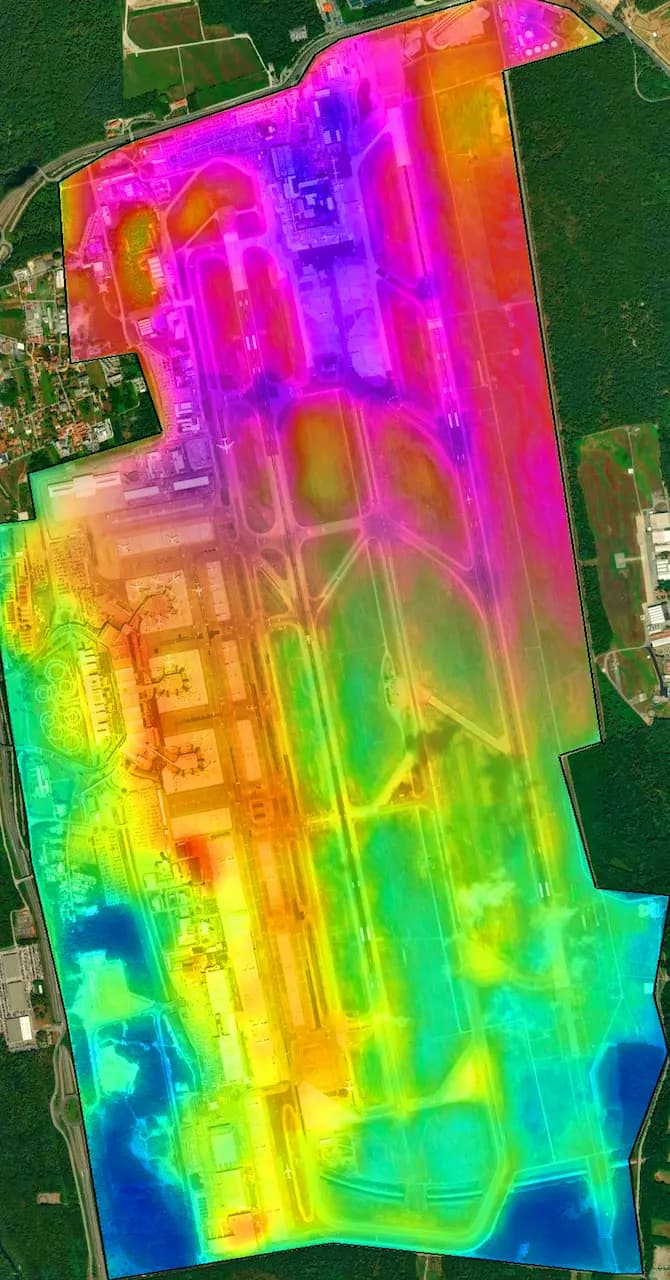
 Contactez-nous pour des informations sur la plateforme ou pour une consultation spécialisée dans le domaine environnemental.