





PollinatorsAvailable
Spectrum: Listen to the pollinators
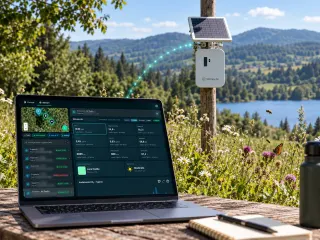
Spectrum listens to the environment and detects the presence of pollinators, classifying them into 19 clusters based on wingbeat frequency. A revolutionary technology for passive biodiversity monitoring.
Field sensors
- 3 meters
- Listening Range
- Unlimited
- Solar autonomy
- 3 months
- Autonomy without sun
01 / 04
Continuous Pollinator Monitoring
Spectrum is 3Bee's proprietary technology for detecting and classifying pollinator insects through bioacoustic analysis of wingbeat frequencies, grouped into 19 specific clusters.
02 / 04
Sensor Spectrum
Field resilience, data precision. A genuine scientific instrument.
- 01
Advanced Bioacoustic Sensor
High-sensitivity MEMS microphone for wing frequencies; Automatic classification into 19 distinct clusters; Non-invasive passive detection; Optimized listening radius of 3 meters - 02
Sustainable Power System
Integrated solar panel for unlimited autonomy; Backup battery for 3 months without sun; Smart energy management; No maintenance required
03 / 04
Key Features
Discover the advanced features that make Spectrum the ideal sensor for monitoring pollinators.
- 01
Wingbeat Frequency Analysis
Detects and classifies insects based on wingbeat frequency, distinguishing among 19 pollinator clusters. - 02
Cluster Classification
Machine learning algorithms group pollinators into 19 distinct clusters based on acoustic characteristics. - 03
Cloud Connectivity
Data is automatically sent to the cloud via 2G/4G network for real-time analysis on the 3Bee platform. - 04
Solar Power
Integrated solar panel for unlimited autonomy. Without sun, the battery guarantees 3 months of operation.
04 / 04
How It Works
The pollinator monitoring process with Spectrum is fully automated and non-invasive.
- 01
Installation
The sensor is placed at strategic points in the area to be monitored. - 02
Passive Detection
Spectrum continuously listens to the environment within a 3-meter radius and detects wingbeat frequencies. - 03
AI Classification
The algorithms automatically classify detected pollinators into 19 distinct clusters. - 04
Visualization
The data are accessible in real time on the XNatura platform dashboard.
From the field · Tuscan Maremma, Italy
The buzzes Spectrum counted in the Tuscan Maremma, Italy
39,530 recordings from 5 sensors between June 2026 and September 2026; 3,750 of them were a pollinator's buzz. Spectrum does not name the species: it sorts every buzz by wingbeat frequency, lower for large insects such as bumblebees, higher for small ones.
- 39,530
- recordings
- 3,750
- pollinator buzzes
- 5
- Spectrum sensors
Buzzes by wingbeat frequency
Three buzzes to listen to

130 Hz

175 Hz

220 Hz
Real platform data, exported on September 23, 2026. The clips are the sensors' original recordings, cut to a few seconds and levelled in volume, nothing else.
Inside the sensor
Spectrum in 3D, from its design files
This model comes from the CAD files the sensor was engineered with. Turn it, get closer and open it to see where the microphone, the boards and the battery sit.
Loading the 3D model...
Drag to turn, scroll or pinch to zoom.
Parts
From the design
- Same platform as Birdy: enclosure, solar panel and 4G radio board.
- A dedicated sampling board analyses the buzz of pollinators.
- The microphone listens through a membrane low on the front cover.
- Overall size 134 x 100 x 171 mm.
Model: Spectrum_rev5.28.STEP
Field sensors
Technical Specifications
Technical details of the Spectrum sensor for professional environmental monitoring applications.
- Listening Range
- 3 meters
- Solar autonomy
- Unlimited
- Autonomy without sun
- 3 months
- Analyzed Clusters
- 19
How to get it
The device comes with an offer from our team
We do not sell sensors from a price list. The team puts together an offer for your project: how many sites and devices, what has to be monitored and for how long, and the subscription to the XNatura platform that turns the readings into species lists, maps and exports.
Field sensors
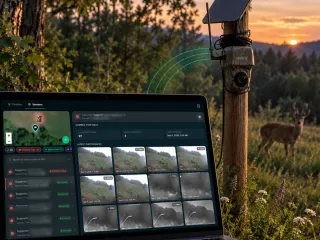
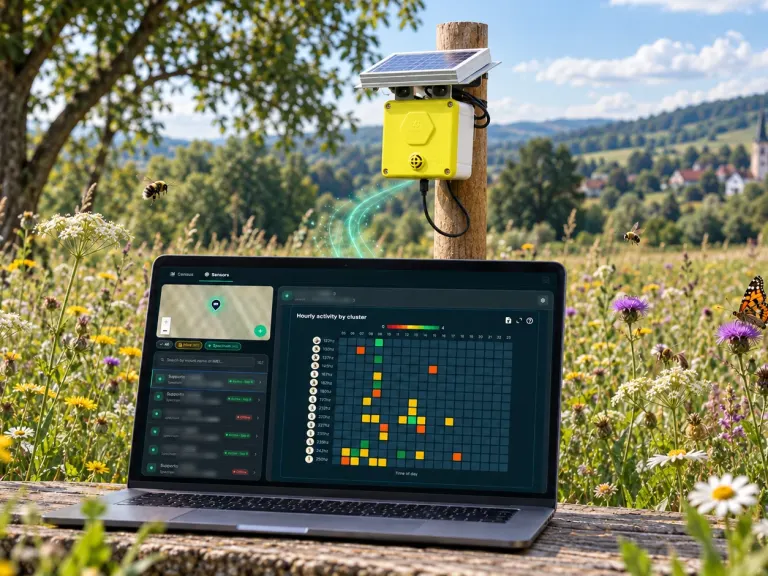
Spectrum in action.
See Spectrum in action in the field.


In the platform
What the data looks like once it is in XNatura
Every reading lands in the site's digital twin, next to the satellite layers and the surveys, and reads as a chart, not as a file.

In the field
Projects where Spectrum is already installed
Case studies whose story names this sensor: what it was asked to measure, and what came out of it.
 AGM Inks · IndustryMonitoring and regeneration of biodiversity at corporate sitesRead the case study
 Air Dolomiti · InfrastructureEmployees in the field, sensors listening: biodiversity takes flightRead the case study
 Alce Nero · AgrifoodOrganic at scale, validated by data from eight sitesRead the case study
FAQ
Frequently asked questions
How does pollinator detection work?
Spectrum uses a high-sensitivity MEMS microphone to capture the sound frequencies produced by the wingbeat of insects within a 3-meter radius. Machine learning algorithms then classify the insects into 19 distinct clusters.
How long does the sensor's battery last?
Thanks to the integrated solar panel, Spectrum has virtually unlimited autonomy under normal irradiance conditions. In case of total absence of sunlight, the internal battery guarantees 3 months of operation.
What are the 19 clusters?
The clusters are groupings of pollinators based on the acoustic characteristics of their wingbeat frequencies. We do not identify individual species, but classify insects into 19 distinct categories representing different types of pollinators.
Why is the range only 3 meters?
The 3-meter range is optimized to ensure maximum accuracy in detecting wingbeat frequencies. This allows high-quality data capture without environmental interference, ensuring accurate classifications.
What is Spectrum?
Spectrum listens to the environment and detects the presence of pollinators, classifying them into 19 clusters based on wingbeat frequency. A revolutionary technology for passive biodiversity monitoring.
How does Spectrum work?
Continuous Pollinator Monitoring. Spectrum is 3Bee's proprietary technology for detecting and classifying pollinator insects through bioacoustic analysis of wingbeat frequencies, grouped into 19 specific clusters.
What are the technical specifications of Spectrum?
Listening Range: 3 meters · Solar autonomy: Unlimited · Autonomy without sun: 3 months · Analyzed Clusters: 19
Start Monitoring Pollinators
Contact us to find out how Spectrum can support your biodiversity monitoring projects.