









XN Ecology · Surveys
Ecological surveys: what lives on the site, group by group
Our ecologists survey habitats, flora and fauna in the field, each group in its season and at its hour, and the sensors keep recording between one visit and the next. The result is the site's species list, with the protection status of each and what follows from it.

The rule
Habitats and species under surveillance, with national protocols
Article 11 of Directive 92/43/EEC asks Member States to keep the conservation status of the habitats and species of Community interest under surveillance, and Article 17 to report on it every six years. In Italy the reference protocols for that surveillance are ISPRA's handbooks of 2016: one volume for animal species, one for plants and one for habitats.
- 1
Before the visit
On the platform: habitats and land use, protected areas, the species expected around the site. It tells which groups need a field survey, and in which season.
- 2
In the field
Group by group, at the right time: amphibians along the wetlands at dusk, by sight and with a net; flora in flower; birds, pollinators and mammals also with Birdy, Spectrum and camera traps.
- 3
The species list
Each species with its protection status, from the annexes of the Habitats and Birds Directives to the IUCN Red List, and the management indications that follow.
Sources: Directive 92/43/EEC, Articles 11 and 17 · ISPRA handbooks for monitoring species and habitats of Community interest, 2016
What we survey
Every group of the inventory, in the field and with sensors
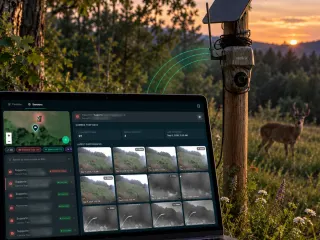
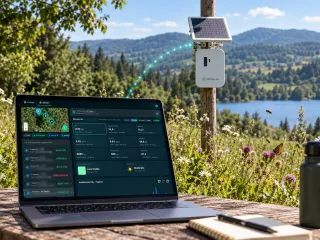
Our ecologists in the field; between one visit and the next, the sensors, which record day and night.
In the field and with sensors
- Habitats and land use, mapped from satellite on the site's perimeter and checked in the field
- Flora, orchids included, with the Biodiversa app: photo, position and an identification the expert validates
- Amphibians and reptiles, surveyed along wetlands, banks and margins
- Birds, recorded continuously by Birdy and validated by an expert, with the diversity indices
- Pollinating insects, whose activity Spectrum sensors measure hour by hour
- Mammals, with camera traps
- Environmental DNA in water samples, analysed by a laboratory
In part
- Bats: night activity yes, recorded by Kiro sensors still in field trials; species and flight paths no
- Trends: one season gives the species list, a trend needs several years on the same points
Outside the survey
- Permits to capture or handle protected species: the authority grants them before the visit (Habitats Directive, Article 16)
- The assessment of a project's effects on those species: it belongs to the impact study, see XN Impact
One spring of surveys
Seven amphibian species in six wetlands
In spring 2026 our survey followed the amphibians of six wetlands of an estate in the Tuscan Apennines, in three visits between April and May, at dusk, by sight and with a net. It recorded seven species: among them the Italian crested newt, in Annexes II and IV of the Habitats Directive, the Italian tree frog and the agile frog, in Annex IV. It also found the native white-clawed crayfish. The report closes with the conservation strategies for the estate, and the sensors keep the monitoring going.
Example reports
See what you receive: real reports, anonymised
Deliverables our experts signed for real clients, with names, places and coordinates removed. Pick one, leave your details and download the PDF straight away.
Your report is ready.
Open it now; a strategist may follow up if it fits a project of yours.
Download the PDF ↓Our systems are temporarily unreachable and the request did not go through. Try again, or write to info@3bee.com.
FAQ
Questions on ecological surveys
Which groups do you survey?
Habitats and flora, insects, amphibians and reptiles, birds, bats and mammals. In the field our ecologists, with the method each group needs; between visits the sensors record birds, pollinators, mammals and bat activity continuously.
When is the right season?
It depends on the group: amphibians in spring, in the breeding season and at dusk; flora when it flowers; birds in the breeding season. Before the visit the platform tells you which groups the site needs.
What do you deliver?
The species list with the protection status of each, the maps of where they were found and the management indications. The data stays on the platform, site by site, so the next survey starts from it.
30 minutes with the team, on XN Ecology.
Video call on Google Meet
Would you rather talk it through?
Either way you are speaking with an AI assistant, and the conversation is transcribed. How we handle your data