











XN Biodiversity · ESRS E4
ESRS E4: biodiversity and ecosystems, site by site
ESRS E4 asks where the company affects nature, near which sensitive areas and with which metrics. We bring the state-of-nature data for each site, measured in the field and from satellite; the double materiality assessment and the reporting stay with the company and its advisers.

The rule
Five disclosure requirements, in the text revised for 2027
Delegated Regulation (EU) 2026/1563 revised the ESRS: it applies to financial years from 1 January 2027, and for 2026 the previous version can still be used. For biodiversity and ecosystems, ESRS E4 sets five disclosure requirements.
- E4-1
Transition plan
How the company responds to the Kunming-Montreal Global Biodiversity Framework, if it has a plan.
- E4-2
Policies
Its policies on biodiversity and ecosystems.
- E4-3
Actions and resources
The main actions and the resources allocated to them.
- E4-4
Targets
Its targets, and how any biodiversity offsets were used.
- E4-5
Metrics
For material impacts: the sites concerned, the biodiversity-sensitive areas near them and the metrics of change.
The platform's data
Primary data on the state of nature, site by site
Under ESRS E4 (AR 11), primary data on the state of nature collected on site or by remote sensing is the best means to determine impacts, especially near sensitive areas. That is the kind of data we produce.
Covered
- The sites and their distance from protected areas and Natura 2000 sites
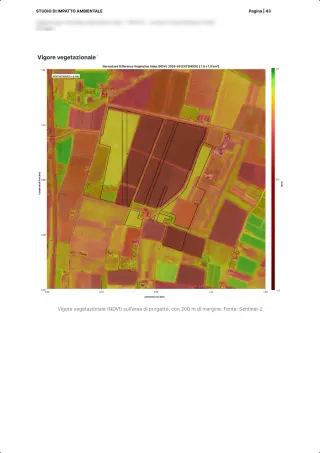
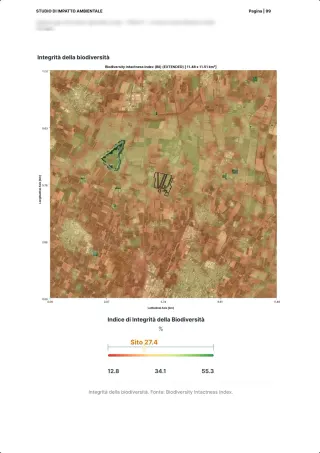
- The state of nature of each site: MSA, land use, habitats and NDVI, against a control area
- Pollinators and birds recorded continuously by field sensors
- A baseline value and year, and monitoring at a stated frequency (AR 12)
In part
- Impacts and dependencies per site, estimated with ENCORE: a starting point, not the materiality assessment
- Threatened species: the species observed, with their IUCN status, not a full census
Stays with the company
- The double materiality assessment: our reports prepare it, they do not replace it
- Transition plan, policies, actions and targets (E4-1 to E4-4)
- Reporting in the sustainability statement, and its assurance
The reports
One sheet per site, and the portfolio
The example reports show what reaches the company: a full site assessment and a multisite report with one sheet per site, its land use, its state of biodiversity and the metrics they relate to. The multisite report also states what it does not yet contain: a full double materiality assessment.
Example reports
See what you receive: real reports, anonymised
Deliverables our experts signed for real clients, with names, places and coordinates removed. Pick one, leave your details and download the PDF straight away.
Your report is ready.
Open it now; a strategist may follow up if it fits a project of yours.
Download the PDF ↓Our systems are temporarily unreachable and the request did not go through. Try again, or write to info@3bee.com.
FAQ
Questions on ESRS E4
Does the CSRD still apply to my company?
After Directive (EU) 2026/470 the CSRD covers companies with more than 1,000 employees and more than 450 million euros of turnover, from financial years 2027. A company below the thresholds can use the same data in voluntary reporting.
Do you carry out the double materiality assessment?
No. Our reports prepare it with site data and a first estimate of impacts and dependencies; the double materiality assessment stays with the company and those who assist it.
What changes with the revised ESRS?
The text of Delegated Regulation (EU) 2026/1563 applies from financial years 2027 and sets five disclosure requirements for E4. For 2026 the 2023 text can still be followed.
30 minutes with the team, on XN Biodiversity.
Video call on Google Meet
Would you rather talk it through?
Either way you are speaking with an AI assistant, and the conversation is transcribed. How we handle your data